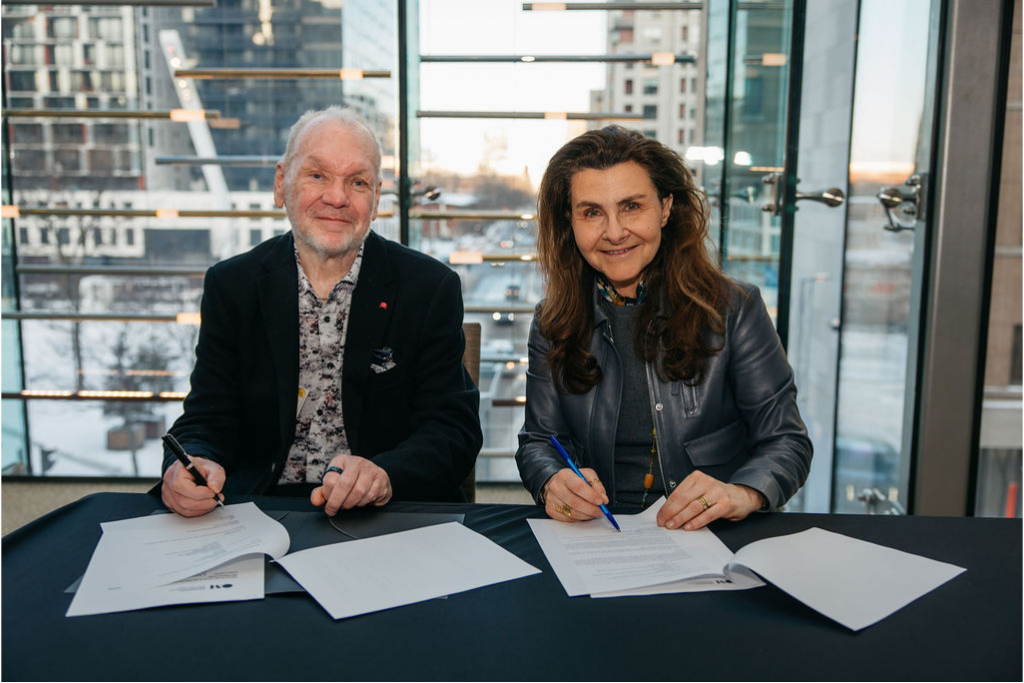
Update – August 2026: Mario Lafond passed away on August 8th. We reflect on his sincere engagement with our orchestra and remained touched by his desire to leave a lasting legacy both during his life and beyond.
Interview conducted during Winter 2026
—
A passionate supporter of the arts, Mario Lafond has nurtured for many years a deep connection with music and the institutions that sustain it.
Recently, he chose to express this attachment by supporting the Orchestre Métropolitain through a gift to its endowment fund and also a bequest in his will. These donations are indicative of a generous and meaningful commitment that reflects both a profound love of music and a desire to contribute sustainably to the Orchestra’s future.
In this interview, he looks back on his journey and shares the convictions that shape his commitment to culture.
Was there a concert or performance that was a true turning point for you—a moment when you realized culture would always hold a central place in your life?
In 2003, during a week of professional training in New York, I took advantage of my evenings to attend several shows, including the musical The Phantom of the Opera. It was a real turning point. I’ve actually seen it several times over the years since then. But above all, that first experience sparked my desire to travel in order to attend performances and concerts.
What was your first encounter with the OM, and what appealed to you about that first concert?
I don’t remember my very first concert with the OM precisely, but it was in the early days of the Maison symphonique. What appealed to me most was the programming. The coherence and the choice of works within a single concert have always been, in my view, one of the OM’s greatest strengths.
In your opinion, why is it important to support culture, and particularly an orchestra like the OM?
Culture has always played an important role in my life, so it felt natural to support it. At first, I tended to favor organizations that seemed less supported by government bodies. Over time, my choices shifted toward organizations whose actions promote inclusion: access to culture for young people, for audiences facing access barriers, and closer ties with the community.
The OM fully embodies this vision, notably through its outdoor concerts, its work in community settings, its support for young people—through the Orchestral Conducting Academy, Tutti, and master classes—and through its competitive pricing, which allows a broad audience to discover symphonic music.
Beyond the financial aspect, what does this philanthropic gesture represent for you?
Above all, it is a human gesture. A way of giving back to organizations that have offered me precious moments of happiness and renewal over the years.
In my professional life, I spent several days a week away from home. Concerts were a way for me to disconnect and refocus. Today, despite health challenges and even if I sometimes have to travel several hours to attend a performance, these moments remain essential. Music brings me an incomparable mental and emotional balance.
How did your reflection unfold around the idea of including a bequest in your will?
Being single and without children, I reflected on the best way to structure my estate. I therefore chose to divide it in two: one portion for my loved ones and another dedicated to donations. It was important to me that this support continue beyond my passing.
The sustainability of donations is fundamental in my view. Giving once is good, but regular donations allow organizations to better plan for the future. I also wanted to inform the organizations concerned, in order to encourage a long‑term perspective.
Many music lovers care deeply about the OM. If there were a first step someone could take to consider making a donation, what would you tell them?
I believe you simply have to start with a first donation, regardless of the timing. I sincerely think that the first donation—no matter the amount—is the real trigger. After that, the scope of donations naturally grows as you see the concrete impact of your contribution.
Recognition programs are also important because, beyond thanking us, they help us better understand how our donations are used.
As for me, once I reached retirement, I favored recurring and multi-year donations rather than one-time gifts.
When you think about the legacy you are leaving, what matters most to you?
The longevity of the work. It is essential that an orchestra like the Orchestre Métropolitain can continue through time while offering concerts of the highest quality.
This involves, in particular, renewing audiences: attracting young people, reaching those who attend only a few concerts per season, and offering a balanced program of classical and contemporary works. The OM is especially well positioned in this regard, and initiatives such as Tutti, for example, play a key role in this renewal.
—
The Orchestre Métropolitain warmly thanks Mario Lafond for his generous and meaningful commitment, which contributes to the Orchestra’s long‑term sustainability.